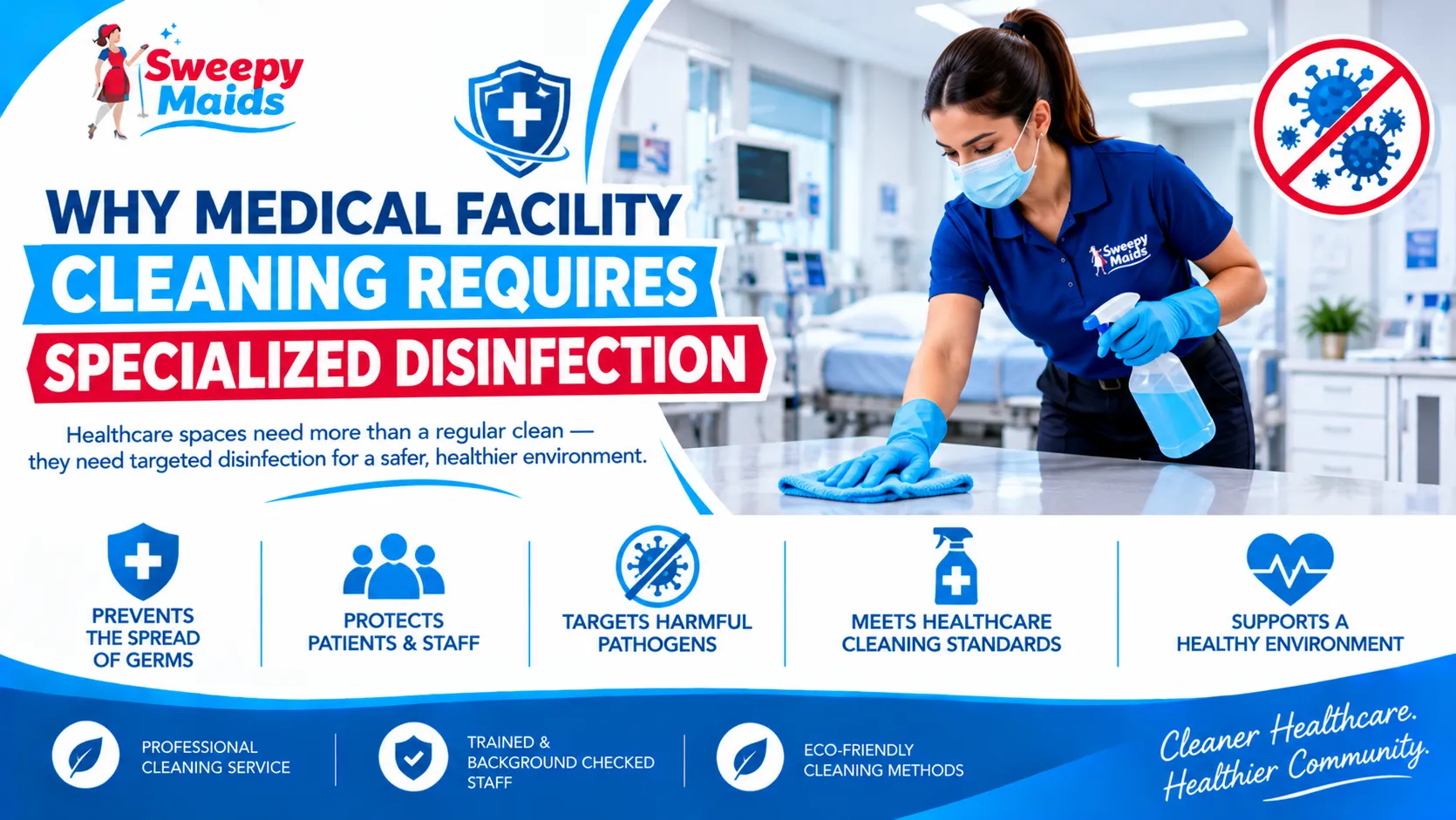

Cleaning a medical clinic, dental office, or physiotherapy practice isn’t the same as cleaning a regular office. Patients who may be sick or vulnerable pass through the same waiting rooms, washrooms, and exam rooms every day, so surfaces need more than a wipe that leaves them looking clean. They need the right disinfectant, applied the right way, for the right amount of time, by people who understand why each step matters.
That’s what “specialized disinfection” really means. It isn’t a fancy product or a marketing term. It’s a process: cleaning surfaces first, choosing disinfectants authorized for use in Canada, keeping surfaces wet for the product’s full contact time, and working in an order that doesn’t spread contamination from dirty areas to clean ones. Standard office cleaning often skips some or all of those steps.
Quick Answer: Medical facilities need specialized disinfection because cleaning alone removes dirt and microorganisms but doesn’t kill them, and disinfection only works properly when surfaces are cleaned first and the product stays wet for its full contact time. Clinics also need disinfectants authorized by Health Canada, frequent attention to high touch surfaces, and staff trained to work from clean to dirty and high to low. A regular office cleaning routine usually isn’t designed around any of these requirements.
Key Takeaways
- Cleaning and disinfecting are different steps. Cleaning physically removes dirt and microorganisms. Disinfection is meant to kill or inactivate what’s left.
- Order matters. Surfaces need to be cleaned before disinfection can be effective.
- Contact time is not optional. Surfaces must stay wet with disinfectant for the time on the product label.
- Products need authorization in Canada. Health Canada now regulates surface disinfectants as biocides, and authorized products carry an 8 digit identification number.
- Training is part of the job. Ontario’s infection prevention best practices call for a trained, educated, and supervised environmental cleaning program in health care settings.
This article is general information, not infection prevention and control (IPAC) advice. Clinics should follow their own IPAC policies, provincial guidance, and any requirements from their regulatory college.
What Medical Facility Cleaning Actually Covers
Medical facility cleaning includes the spaces patients and staff use every day:
- Waiting rooms, reception desks, and check in areas
- Exam rooms, treatment rooms, and procedure areas (non sterile surfaces)
- Washrooms and staff rooms
- High touch points such as door handles, light switches, chair arms, counters, and card machines
- Floors, including hard flooring and any carpeted offices
It typically does not include sterilizing medical instruments or reprocessing medical devices. That work follows separate protocols and is usually handled by clinical staff.
Cleaning vs Disinfection: What’s the Difference?
Cleaning uses detergent, water, and physical scrubbing to remove dirt, organic material, and many microorganisms from a surface. According to Public Health Ontario’s best practices, cleaning physically removes rather than kills microorganisms. Disinfection uses a chemical product to kill or inactivate microorganisms that remain. The two work together, and skipping either step reduces how well the other one works.
Standard Commercial Cleaning vs Medical Facility Cleaning: Side by Side
| What You’re Comparing | Standard Commercial Cleaning | Medical Facility Cleaning |
| Main goal | A clean, presentable workspace | Clean and properly disinfected surfaces |
| Products | General cleaners | Cleaners plus disinfectants authorized by Health Canada |
| Contact time | Often wipe and go | Surfaces kept wet for the label’s full contact time |
| Cleaning order | Varies | Clean to dirty and high to low |
| High touch surfaces | Wiped during routine visits | Cleaned and disinfected frequently, at least daily |
| Staff training | General cleaning skills | Training in disinfection methods and health care settings |
| Documentation | Rarely required | Checklists and logs often expected by the clinic |
READ MORE: How Often Should a Commercial Office Be Cleaned?
What Makes Disinfection “Specialized”
Cleaning comes first. Public Health Ontario’s best practices state that items must be cleaned thoroughly before effective disinfection can take place. Disinfectant sprayed onto a dirty surface doesn’t do its job properly.
Contact time is followed exactly. Public Health Ontario’s environmental cleaning resource says the surface should remain wet for the required contact time, and that disinfectant should be reapplied if that time isn’t met. Every product’s label lists its own contact time.
The work follows a set order. Cleaners work from clean to dirty and from high to low, so dirt and microorganisms don’t drip down or get carried onto areas that have already been cleaned.
High touch surfaces get extra attention. Door handles, light switches, counters, and chair arms are touched constantly. Public Health Ontario’s resource recommends cleaning and disinfecting high touch surfaces at least once per day.
Where Standard Office Cleaning Falls Short
Wrong products or no disinfection step. Many routine office cleans use general purpose cleaners only, which remove dirt but aren’t designed to disinfect.
Rushed contact times. Spraying and immediately wiping a surface means the disinfectant may not stay wet long enough to work as labelled.
No training for health care settings. Cleaners who usually work in offices or homes may not know clean to dirty workflows, how to handle shared equipment, or which areas need extra care. Ontario’s best practices call for an appropriately staffed, trained, educated, and supervised environmental services program in health care settings.
Did You Know? According to Health Canada, surface disinfectants and sanitizers are now regulated as “biocides” under the Biocides Regulations, which came into force on May 31, 2025. Authorized biocides are assigned an 8 digit identification number, and disinfectants previously sold with a Drug Identification Number (DIN) keep the same number sequence. Products authorized under the old rules have until May 31, 2029 to transition. When you hire a cleaning provider for a clinic, it’s reasonable to ask which disinfectants they use and to check that each one carries an authorized 8 digit number.
READ MORE: In House Janitorial vs Outsourced Commercial Cleaning: What’s Better for Your Business?
How to Choose a Medical Facility Cleaning Provider
Ask about products and processes. Request a list of the disinfectants they use, check each product’s identification number, and ask how they make sure contact times are met.
Ask about training and supervision. Find out how cleaners are trained for health care settings and who checks their work. Our guides to cleaning companies vs independent cleaners and finding reliable cleaners in Langley cover insurance, WorkSafeBC clearance letters, and other basics to check.
Decide between in house and outsourced. Some clinics train their own staff, while others contract a cleaning company. Our guide to in house janitorial vs outsourced commercial cleaning and our cost vs time breakdown explain the trade offs.
Set a schedule and a checklist. Agree on daily, weekly, and periodic tasks, and ask for a written checklist. Our guide to recurring vs one time cleaning service can help you decide what should be on a regular schedule.
Looking for cleaning support for your clinic or medical office? Get a free quote from Sweepy Maids and ask about our disinfection process and products.
Frequently Asked Questions
What’s the difference between sanitizing and disinfecting?
Health Canada regulates both surface sanitizers and surface disinfectants as biocides. In general terms, sanitizers reduce microorganisms on surfaces, while disinfectants are intended to kill or inactivate a broader range of them. Always check a product’s label for what it’s authorized to do.
How often should a medical clinic be cleaned?
It depends on patient volume, the type of practice, and the clinic’s IPAC policies. Public Health Ontario’s resource recommends that high touch surfaces be cleaned and disinfected at least once per day, with more frequent attention in busy areas.
Do medical facility cleaners sterilize instruments?
Usually not. Sterilizing instruments and reprocessing medical devices follows separate protocols and is generally handled by trained clinical staff, not environmental cleaners.
Is medical facility cleaning more expensive than office cleaning?
It often costs more because it takes more time, more specialized products, and more training. Our guide to the deep cleaning vs standard cleaning price difference in Canada explains how scope and detail affect price.
What about carpets in medical offices?
Hard floors are easier to clean and disinfect, but some offices and waiting rooms still have carpet. See how often to get professional carpet cleaning and our comparison of steam cleaning vs shampooing carpets.
Related Cleaning Guides
- A Homeowner’s Guide to Commercial Cleaning in Abbotsford
- How Often to Deep Clean Your House, Room by Room
- Average Cost of Weekly House Cleaning in Calgary
- The Complete Guide to Booking Airbnb Cleaning in Vancouver
- Airbnb Turnover Cleaning Cost in Surrey and Kelowna
- Move In vs Move Out Cleaning: A Renter’s Timeline
- What to Expect From a Move Out Cleaning Service in Vancouver
- Move Out Cleaning Checklist to Get Your Full Damage Deposit Back
- What’s Included in a Professional Move In Cleaning?
About the Author
Parth Katyal is the founder of Sweepy Maids and a cleaning industry specialist with more than 10 years of experience serving Canadian homeowners and businesses. Sweepy Maids started in Surrey, BC and now operates across Metro Vancouver, the Fraser Valley, Vancouver Island, Kelowna, Calgary, Brampton, Edmonton, and Montreal, including our Vancity Newton branch. Parth’s focus on eco friendly products, bonded and background checked staff, and transparent pricing shapes how Sweepy Maids approaches every space it cleans.